When a Muslim mob destroyed a Christian family’s pig farm, police initially refused to even register the case. A Christian hotline network supported by CSI mobilized to demand that authorities act. The tepid response has intensified concerns over growing Islamist influence ahead of national elections happening February 2026.
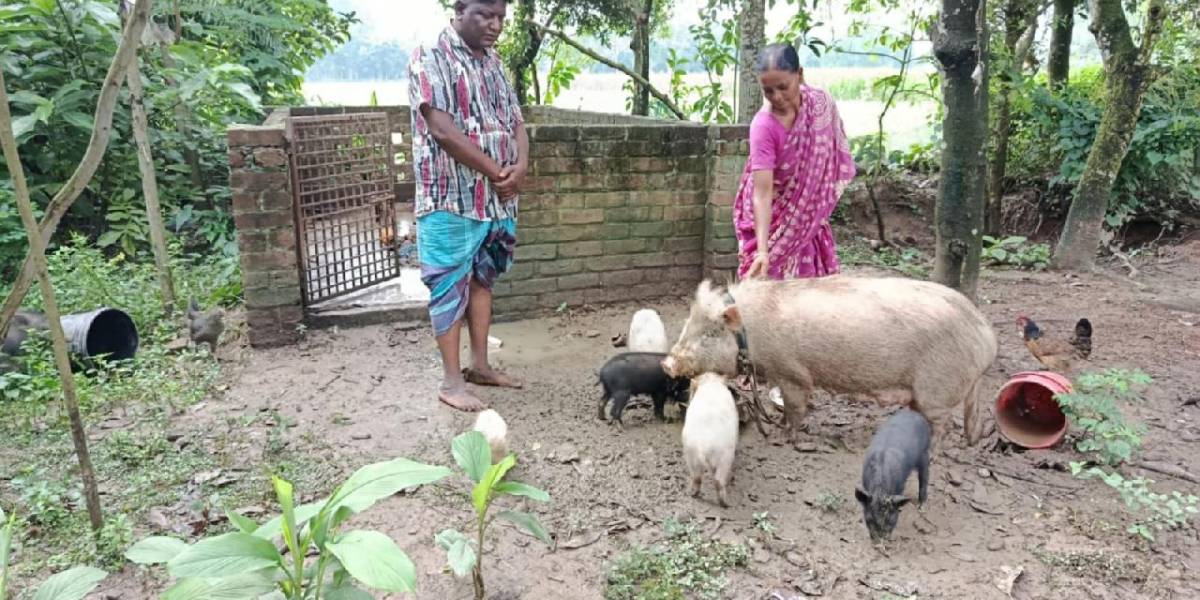
A Christian family raising pigs in a Bangladesh village had their farm attacked by a mob earlier this year. photo provided to csi
A Christian man’s pig farm was destroyed by a mob in Muslim-majority Bangladesh after a local mosque issued a religious decree banning pig farming in the area. The attack, and authorities’ reluctance to respond, has intensified fear among the Christian minority as the country moves toward national elections in February 2026 under a fragile interim government.
The incident took place in a small village within Rangpur district in northern Bangladesh, a South Asian country that is home to over 170 million people, bordered by India and Myanmar. The country’s population is predominantly Muslim, with around 91% practicing Sunni Islam. Christians make up less than 0.5%—about 400,000 people—and often belong to historically marginalized indigenous or Dalit communities.
Imam’s religious order prompts aggression against traditional Christian livelihood
On the morning of January 7, Peter (name changed), a Christian man from one such indigenous Dalit group, had no reason to expect trouble. He was tending to his pig farm, a traditional livelihood known locally as Tari Papesha, which includes raising pigs and consuming pork – practices that have been part of his community’s identity for generations.
In the afternoon, shortly after Friday prayers at the local mosque, a group of 15 to 20 men, led by the mosque’s imam, approached Peter. They carried with them a religious order, or fatwa, declaring a ban on pig farming in the area. Peter responded that pig farming was a deeply rooted cultural practice in his community. His answer provoked anger.
The group stormed his farm, killed 11 pigs and warned that any home continuing the practice would be burned.
Christian network pushes police to act
Shaken but determined to seek help, Peter contacted a local church leader and a volunteer for a nationwide emergency hotline coordinated by a Christian support network. The pastor traveled more than 20 kilometers that night by motorcycle to reach Peter. Together with another pastor, he went to the local police station to file a complaint.
The police refused to record the case. Officers told them the issue was too sensitive because it involved pigs, which are considered impure in Islam. The pastor escalated the matter to the network’s central office in Dhaka, Bangladesh’s capital. The office contacted a local correspondent for a national newspaper, who then called the officer-in-charge of the police station. The journalist warned that if police failed to act, the story would be published. Only after this intervention did the police register the case.
However, the first report understated what had happened, saying only that mosque members had objected to pig farming. After continued pressure, the complaint was updated to include the killing of the pigs and the threat to burn homes.
CSI’s local partner later helped Peter rebuild two destroyed pigsties. Though the pigs could not be replaced, and the fear remained, the support for rebuilding the structures gave the Christian community some relief.
The case was processed through a hotline system, established by CSI’s partner. Through the hotline network, local pastors, volunteers, and legal representatives provide an immediate response. Victims or their families can call in emergencies, activating a coordinated response across regions with lawyers, police and local authorities. A detailed report is then reviewed by the central office and decisions on how to best support the case are made. The type of support can range from medical assistance to rebuilding costs or relocation funds, depending on the situation.
Political instability surrounds government transition
This attack occurred against a larger backdrop of political instability and anxiety across Bangladesh.
In the summer of 2024, a student-led uprising known locally as the “July Revolution” forced Prime Minister Sheikh Hasina to flee the country. Her government had been accused of authoritarianism and violent crackdowns that left hundreds of young protestors dead.
Following the uprising, a caretaker government was installed under Muhammad Yunus, a Nobel Peace Prize-winning economist known internationally for pioneering microfinance. His interim administration banned Hasina’s ruling party, the Awami League, under the country’s Anti-Terrorism Act and brought charges of crimes against humanity against her.
But the change in leadership has not brought lasting peace.
Radical Islam gains ground, stokes violence against religious minorities
In the months after Hasina’s removal, Rights and Risks Analysis Group reported a total of 1,090 attacks against members of minority communities between August 5 and 20, 2024. These included damage to 1,068 homes and businesses and 22 places of worship. Two Hindu men were killed in separate incidents during August 2024.
Islamist groups have also begun to re-emerge in public life. The Jamaat‑e‑Islami party, previously banned for its extreme views and alleged ties to violence, has regained legal status and is now openly holding rallies and participating in politics. There is growing concern that its influence could spread through coalitions with other parties in the upcoming elections.
A newly formed party, the National Citizens’ Party (NCP), emerged from the student protests that toppled Hasina’s government. While it includes many young democratic leaders, some of its members hold radical Islamist views. Several of them are already part of the interim administration. The party has not defined its ideology clearly, raising further uncertainty about its political direction.
In Bangladesh, political coalitions are often necessary to form governments. While it is not expected that Jamaat‑e‑Islami or other Islamist groups will win elections outright, they could play a significant role in any future coalition. The Bangladesh Nationalist Party (BNP), one of the country’s two largest political parties alongside the now-banned Awami League, could turn to Jamaat if it does not secure a majority. The same concern applies to the NCP, whose composition already includes Islamist elements.
Public pressure is needed to protect minority rights in Bangladesh
For many citizens who support secularism, civil liberties and religious freedom, these developments raise fears of democratic backsliding. There is growing unease that this wave of religious conservatism may shape governance, roll back freedoms and increase threats against minorities and dissenters. In this climate, the attack on Peter is therefore seen not as an isolated case but as part of a larger pattern of discrimination and violence that could become more common during the election buildup.
The case also shows the limits of legal protection. Even under a transitional government that claims to support democratic norms, local police failed to act without media pressure. This reflects ongoing structural weaknesses in law enforcement and suggests that minority rights remain precarious, especially in rural areas.
What stands out is the role of local pastors, independent media and grassroots networks in responding to the crisis. Without their swift intervention, the incident might never even have entered official records. But the reliance on such actors also signals a deeper problem – the absence of consistent state protection for minorities in volatile political environments.
As Bangladesh moves closer to its next election, the safety of religious minorities remains uncertain. The pig farm attack is one of several incidents that point to rising tensions in local communities. With Islamist groups regaining visibility and political alliances still forming, the months ahead could see further intimidation or violence unless stronger protections are enforced nationwide.